Historicity of the history - where is it written, where is the evidence? Why is it missing?
1272 Đại Việt sử ký
The Đại Việt sử ký was written by Lê Văn Hưu (1230-1322) in 30 volumes and finished by 1272. None of these works survived, but has been used as a source for the Đại Việt sử ký toàn thư from 1479.
According to Wikipedia, “during the Fourth Chinese domination (1407-1427), many valuable books of Đại Việt were taken away by the Ming dynasty including the Đại Việt sử ký, hence the book was subsequently lost.“. For details, see:
- See Taylor, Keith Weller (1991), The Birth of Vietnam, University of California Press, ISBN 0-520-07417-3, page 351
- Trần Trọng Kim (1971), Việt Nam sử lược (in Vietnamese), Saigon: Center for School Materials, page 82
- National Bureau for Historical Record (1998), Khâm định Việt sử Thông giám cương mục (in Vietnamese), Hanoi: Education Publishing House, page 356
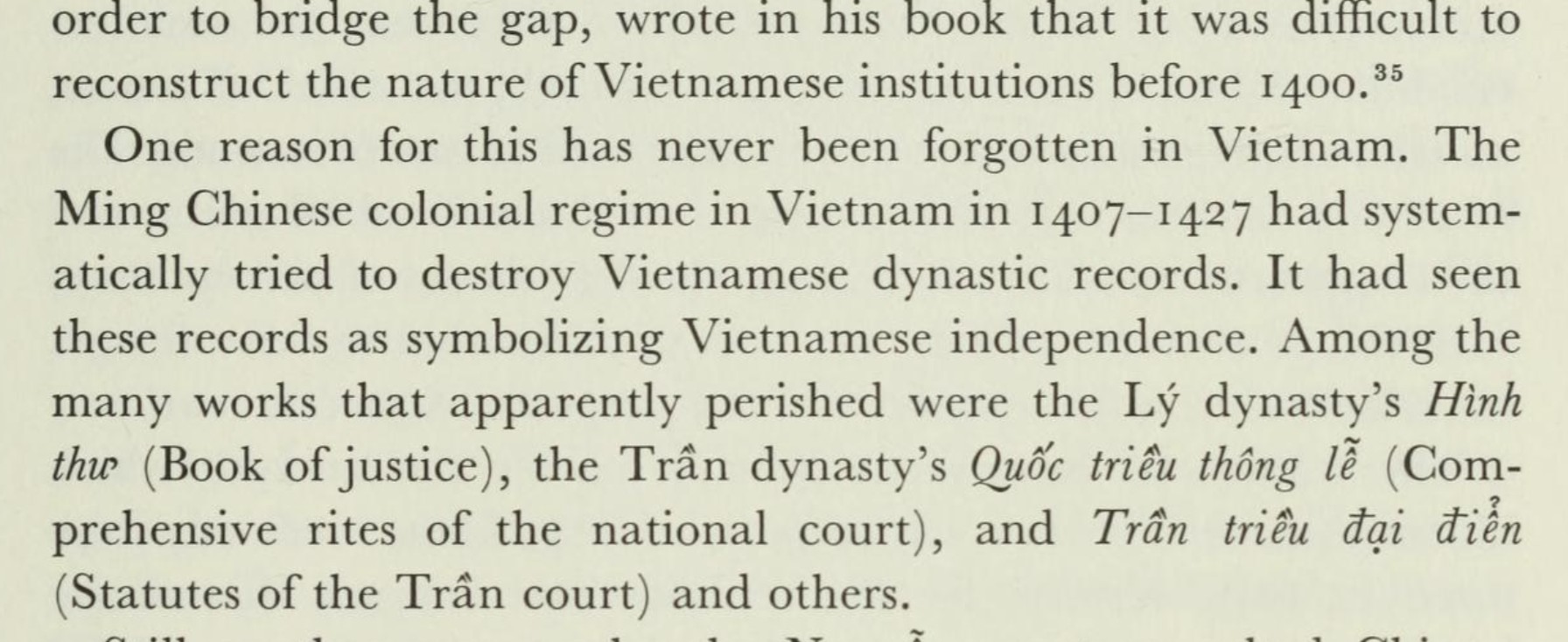
- Woodside, Alexander (1988). Vietnam and the Chinese model: a comparative study of Vietnamese and Chinese government in the first half of the nineteenth century. Harvard Univ Asia Center. pp. 125. ISBN 0-674-93721-X.
From source 4 on page 125 it states:
Đại Việt sử ký tục biên
This is the second source for the Đại Việt sử ký toàn thư by Ngô Sĩ Liên from 1479. It was written by Phan Phu Tiên (chữ Hán: 潘孚先, 1370–1482). He was charged by Lê Nhân Tông with writing the annals of the preceding Tran dynasty (1225-1400). This second source must have been written in the early 15th century, but there is not even a Wikipedia article about this source.
There are probably no surviving fragments of this document. Since the fourth Chinese domination began 1407 I assume it was compiled before that, and then destroyed in the following 20 years.
1479 Đại Việt sử ký toàn thư
The Đại Việt sử ký toàn thư (chữ Hán: 大越史記全書; Vietnamese: ɗâːjˀ vìət ʂɨ᷉ kǐ twâːn tʰɨ; Complete Annals of Đại Việt) is the official national chronicle of the Đại Việt, that was originally compiled by the royal historian Ngô Sĩ Liên under the order of the Emperor Lê Thánh Tông and was finished in 1479 during the Lê period.
There seems to be no documents or writings from this time that survived to this day. If there is a reference to some fragments in a special library in Hanoi (or elsewhere), please comment here.
In the Wikipedia article to Historical perspectives it states “Ngô Sĩ Liên took a further step by identifying the mythical and historical figures Kinh Dương Vương and his son Lạc Long Quân as the progenitor of the Vietnamese people. Because of the lack of historical resources about Kinh Dương Vương and Lạc Long Quân, some suggests that Ngô Sĩ Liên’s explanation of the Vietnamese people’s origin was a measure to extend the longevity of the Vietnamese civilization rather than a literal point of departure. … Ngô Sĩ Liên defined it the first Vietnamese dynasty which reigned the country from 2879 BC to 258 BC and thus predated the Xia dynasty, the first dynasty of China, for more than 600 years. 8 However, Ngô Sĩ Liên’s account for that long period was so brief 53 that several modern historians challenged the authenticity of his chronology for the Hùng Vương, kings of the Hồng Bàng dynasty, and speculated that Ngô Sĩ Liên created this specific chronology mainly for the political purpose of the Lê dynasty. 54”
1665 Đại Việt sử ký toàn thư tục biên
The 23-volume Đại Việt sử ký toàn thư tục biên (Continued Compilation of the Complete Annals of Đại Việt) was published under the supervision of Phạm Công Trứ in 1665.
No Wikipedia article for this edition, print or further details. Not even in Vietnamese.
1697 Đại Việt sử ký toàn thư - Nội các quan bản
The “Nội các quan bản” edition, the most comprehensive and popular version of Đại Việt sử ký toàn thư, was printed in 1697 during the Chính Hòa era by efforts of the historian Lê Hi. sources 7, 11 and 12
If we have a print from 1697, then it is 2024-1697=327 years old. It would be weird if the oldest fragment of Vietnamese history is only 300 years old, yet trying to talk about a time period from 2879 BC with the birth year of Kinh Dương Vương some 2879+2024=4903 years ago. While we don’t know when the oldest known historian, Ngô Sĩ Liên, was even born in the 15th century (a little more than 500 years ago), this traces history back thousands of years. Using evidence only 300 years old.
Historicity
Wikipedia states that this edition is fully preserved. In Đại Việt sử ký toàn thư it states under Edition: “Today, a complete set of the “Nội các quan bản” edition is kept in the archives of the École française d’Extrême-Orient in Paris, France.”
The content is digitally available at: ____ insert here ___
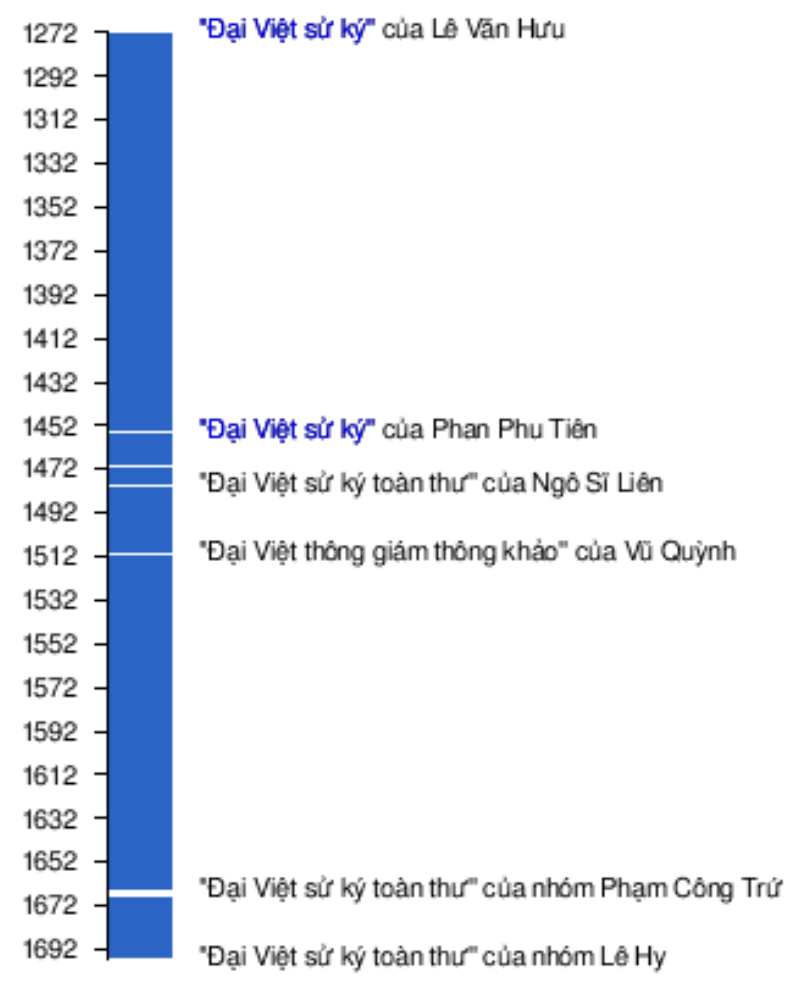
Timeline
The Vietnamese article has an interesting timeline that reflects the findings of this writing:
Digital resources
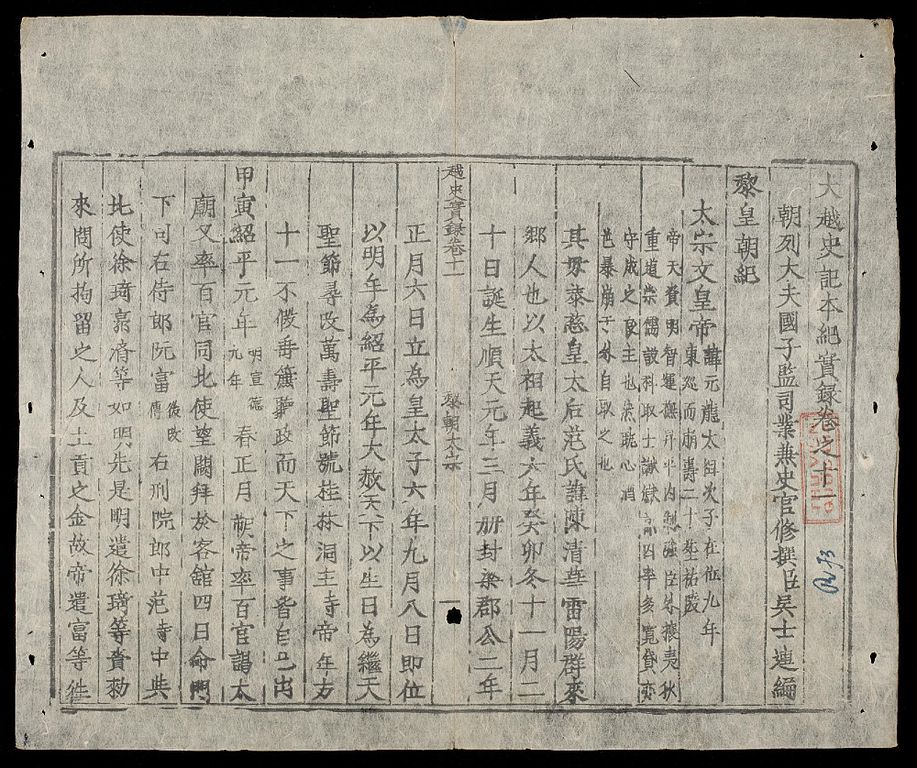
The nom foundation (website) has digital images of the Đại Việt sử ký toàn thư from the 15th century. For example this image (uploaded to Wikipedia 2013, its 0144-11 ):

2008 Digitization project of the NOM foundation
It appears that between 2006 and 2009 the NOM foundation visited Hanoi and put effort into the digitalization of ancient documents. See this image collection in their homepage. They call it The Hán Nôm Special Collection Digitization Project at the National Library of Vietnam.
Digital collection
The foundation has a dedicated website of digital documents: https://lib.nomfoundation.org/collection/1/?uiLang=en


Scans of Đại Việt sử kí toàn thư
From the National Library of Vietnam 大越史記全書 | Đại Việt sử kí toàn thư ( q.11) https://lib.nomfoundation.org/collection/1/volume/183/ , scanned 2008
Volume 11, 99 pages
https://lib.nomfoundation.org/collection/1/volume/183/page/1
Volume 12, 73 pages
https://lib.nomfoundation.org/collection/1/volume/184/
Volume 13 to 18
- 13 https://lib.nomfoundation.org/collection/1/volume/185/ 85 pages
- 14 https://lib.nomfoundation.org/collection/1/volume/186/ 55 pages
- 15 https://lib.nomfoundation.org/collection/1/volume/187/ 78 pages
- 16 https://lib.nomfoundation.org/collection/1/volume/188/ 67 pages
- 17 https://lib.nomfoundation.org/collection/1/volume/189/ 75 pages
- 18 https://lib.nomfoundation.org/collection/1/volume/190/ 37 pages
This makes me wonder: where is volume 1-10? And 19-23? And what is actually written there?
Vietnamese and English translation
Someone has to add them, now that I found images of the wood prints from 1697. And are there older originals and fragments? And where are they?
Vietnamese article of Go Zhen Feng
On the website http://www.hannom.org.vn/web/tchn/data/9002_a.htm there is a Vietnamese article by Go Zhen Feng about the print from 1697. It states:
ĐẠI VIỆT SỬ KÝ TỤC BIÊN
Thời kỳ Hậu Lê (1428-1788) của Việt Nam, xuất hiện nhiều nhân tài sử học, nhiều tác phẩm sử học nổi danh, đặc biệt có ba bộ sử nổi tiếng nhất, đó là: Đại Việt sử ký toàn thư của Ngô Sĩ Liên, bản Hồng Đức; Đại Việt sử ký tục biên của Phạm Công Trứ, bản thời Cảnh Trị; Đại Việt sử ký toàn thư của Lê Hi, bản năm Chính Hòa… Ba bộ sử này đã trở thành tác phẩm tham khảo có giá trị nhất đối với việc nghiên cứu xã hội phong kiến Việt Nam, chính vì thế được giới sử học hai nước Trung Quốc và Việt Nam coi trọng.
Bộ Đại Việt sử ký toàn thư gồm 15 quyển (bản), biên soạn năm 1479, có tác dụng đặt nền móng cho công tác biên soạn lịch sử Việt Nam, song tập sách này đến nay không còn đầy đủ. Bộ Đại Việt sử ký tục biên gồm 23 quyển khắc in năm 1665 là bộ chính sử được bảo tồn khá đầy đủ của Việt Nam. Bộ Đại Việt sử ký toàn thư, bản khắc in năm 1697, là bộ quốc sử của Việt Nam được bảo toàn đầy đủ nhất, có giá trị nhất, hiện nay nhiều nhà sử học Trung Quốc thường thấy, chính là bộ “Toàn thư” này. Bộ “Toàn thư” của họ Ngô và họ Lê do có nhiều học giả đã nghiên cứu và có những kết luận thỏa đáng, cho nên trong phạm vi bài này, chỉ giới thiệu bộ “Tục biên” của họ Phạm, vì bộ sử này chưa được các nhà nghiên cứu đánh giá đầy đủ.
1. Lý do biên soạn và nội dung cơ bản bộ “Tục biên” của Phạm Công Trứ:
Phạm Công Trứ (1599-1675) là người thôn Liễu Xuyên, huyện Đường Hào (nay là huyện Mỹ Văn, tỉnh Hải Hưng), xuất thân trong một gia đình nhà nho có quyền thế thời phong kiến. Tổ tiên ông đời đời làm quan. Từ nhỏ, ông đã được trời phú bẩm thông minh, học tập cần mẫn, đọc nhiều kể cả thư tịch Trung Quốc, văn chương xuất chúng, được nhiều người ngưỡng mộ. Phạm Công Trứ thi đậu Tiến sĩ (năm 1628) vào lúc quyền lực của nhà vua suy yếu, hữu danh vô thực, quyền hành thực sự nắm trong tay Trịnh Tráng và Trịnh Tạc. Họ Phạm đã từng giữ chức Lại bộ Thượng thư kiêm Đông các đại học sĩ, một chức vụ quan trọng trong chính quyền Lê-Trịnh.
Vua Trần Tông và Huyền Tông ở ngôi trị vì, nhưng ham mê tửu sắc, suốt ngày trong cung cấm, quên hết công việc triều chính. Đặc biệt, Huyền Tông lên ngôi lúc 3 tuổi, chưa nắm được việc nước, năm 19 tuổi thì bị hại, mọi công việc đều do Trịnh Tráng và Trịnh Tạc điều hành. Các nhà sử học Việt Nam trước đây hoàn toàn phủ nhận vai trò của cha con họ Trịnh trong vấn đề dựng nước. Như thế là không thỏa đáng. Việc phê phán sự độc đoán của họ Trịnh là cần thiết. Song, cha con họ Trịnh phản đối việc tranh giành bá quyền của bọn cường hào, phản đối chia cắt đất nước, chủ trương ổn định để phát triển đất nước, thực hiện chính sách hữu nghị với Trung Quốc, điều này cần được khẳng định (tr.59).
Lúc bấy giờ, phần nhiều các nho sĩ trong triều, ngoài nội đều ngưỡng mộ họ Trịnh, họ giúp mưu hiến kế cho nhà Trịnh, vì thế được trọng dụng, Phạm Công Trứ cũng trong số đó, và khi ông biên soạn bộ Đại Việt sử ký tục biên, đã qui công, ca ngợi Trịnh Tráng và Trịnh Tạc.
Lý do Phạm Công Trứ biên soạn bộ Đại Việt sứ ký tục biên là:
- Phạm Công Trứ với tư cách là Lại bộ thượng thư kiêm Đông các đại học sĩ trong chính quyền Lê-Trịnh, ông có học vấn uyên bác, tinh thông các thư tịch lịch sử bằng Hán văn, nên rất được họ Trịnh quý trọng. Bản thân Phạm Công Trứ cũng rất trông mong vào sự điều hành công việc tốt đẹp của họ Trịnh, nên ông rất hăng hái với học thuật, như viết sách lập ngôn, ca ngợi công tích của họ Trịnh. Do vậy họ Trịnh đã sai ông viết sử, năm đó là năm 1662.
- Bộ “Toàn thư” do Ngô Sĩ Liên biên soạn gồm 15 quyển, mới ở dạng chép tay, chưa có bản in, cũng chưa được công bố trong cả nước, thậm chí bản thảo và bản chép của tác giả cũng không được bảo tồn hoàn chỉnh. Đặc biệt bộ sử này mới ghi chép về những năm đầu của Lê Lợi, tức Lê Thái Tổ (1418-1443); một số hoàng đế về sau, từ Thái Tông đến Huyền Tông, suốt 15 đời đều chưa được biên soạn chính thức. Mãi đến khi Trịnh Tác nắm quyền (tức là sau khi Huyền Tông kế vị) mới ra lệnh cho nhà sử học Phạm Công Trứ viết bổ sung thêm.
- Phạm Công Trứ cho rằng sự tích của tất cả các vị vua của nước nhà cần được ghi chép lại, cùng với những việc làm tốt, xấu và cách trị nước của họ, lấy đây làm bài học trị dân, giữ nước lâu dài (xem lời tựa trong “Tục biên” của Phạm Công Trứ).
Về thời gian, nội dung cũng như tư liệu để biên soạn, có những điểm đáng chú ý sau đây: Đại Việt sử ký tục biên bắt đầu chép từ năm 1662, tức là lúc Lê Thần Tông lên ngôi, và hoàn thành vào năm 1665, tức đời vua Lê Huyền Tông, năm Cảnh Trị thứ 3.
Tham gia biên soạn “Tục biên” gồm 13 nho sĩ, do Tham tụng Lại bộ Thượng thư kiêm Đông các đại học sĩ Phạm Công Trứ đứng đầu. Bộ “Tục biên” viết 3 giai đoạn lịch sử: 1522-1527; 1533-1541; 1619-1662.
Nếu so sánh với các bộ sử trước đó, có thể thấy:
- Phạm Công Trứ vẫn kế thừa cách phân kỳ trong “Toàn thư” của Ngô Sĩ Liên (về phần ngoại kỷ và bản kỷ).
- Tiếp thu cách chia giai đoạn trong Việt giám thông khảo của Vũ Quỳnh (gồm “Ngoại kỷ”, từ Hồng Bàng Thị năm 258 trước Công nguyên, đến 12 Sứ quân (năm 945-967); “Bản kỷ” bắt đầu từ Đinh Tiên Hoàng (năm 968-980) cho tới Lê Triều (Cao Hoàng đế - Lê Lợi, năm 1428).
- Họ Phạm lại chia “Bản kỷ” thành 3 phần nhỏ:
a, “Bản kỷ toàn thư”, từ Đinh Tiên Hoàng (năm 968-970) đến Lê Thái Tổ (1428-1433). b, “Bản kỷ tục biên”, từ Lê Thái Tông (1434-1442) đến Cung Hoàng (1522-1527). c, “Bản kỷ tục biên” từ Lê Trang Tông (1533-1548) đến Lê Thần Tông (1649-1662).
Bộ Sử của họ Phạm là sự tiếp thu phần nội dung “toàn thư” của họ Ngô và đặt cơ sở cho nội dung “Toàn thư” của Lê Hi sau này.
2. Mấy vấn đề liên quan tới “Tục biên” của họ Phạm:
Đọc lời tựa “Tục biên” của họ Phạm, thấy có mấy vấn đề cần chú ý sau:
1, “Ngoại kỷ toàn thư” và “Bản kỷ toàn thư” của họ Phạm được dựa trên cơ sở tác phẩm nổi tiếng của Ngô Sĩ Liên và Vũ Quỳnh, đồng thời ông cũng tham khảo Việt giám khảo tổng luận của Lê Tung và Việt sử thi tập của Đặng Minh Khiêm, nhưng có sự khảo đính tỉ mỉ hơn. Ngoài ra, còn tham khảo sử ký Trung Quốc để biên soạn thành bản chính.
2, “Tục biên” của họ Phạm, những phần kỷ niên, phàm lệ và sách tham khảo đều theo sử sách chính thống của Việt Nam và Trung Quốc.
3, Bộ “Tục biên” gồm 23 quyển của họ Phạm được lưu giữ ở Trung Quốc là thuộc loại thiện bản. Nhưng việc đưa đi khắc in “bản ký tục biên” mới chỉ được 5, 6 phần. Điều này cho thấy quốc sử Việt Nam cũng chỉ khắc in, công bố 5,6 phần mà thôi. Cơ cấu toàn bộ bộ “Tục biên” đã được Lê Hi sử dụng, đưa vào “Toàn thư”, đồng thời cũng tiến hành chú thích phần “Phàm lệ” trong “Toàn thư” của Ngô Sĩ Liên. Và đầu quyển “Tục biên” của họ Phạm có thêm phần “Lời tựa”, việc này có tác dụng khá lớn đối với sự hoàn thiện, phát triển nền sử học Việt Nam. Chính vì lý do đó, tác phẩm sử học của Phạm Công Trứ được giới sử học sau này ca ngợi.
- Đại Việt sử ký tục biên sơ thám. Bài viết của Go Zhen Feng, đăng trên Tạp chí Đông Nam Á (Viện khoa học xã hội tỉnh Vân Nam, Trung Quốc), số tháng 1-1989, tr.59-61./.
Google translation of the article into English
ĐẠI VIỆT SỬ KÝ TỤC BIÊN
During the Later Le Dynasty (1428-1788) of Vietnam, many talented historians and famous historical works appeared, especially the three most famous historical works, which are: Dai Viet Su Ky Toan Thu by Ngo Si Lien, Hong Duc edition; Dai Viet Su Ky Tuc Bien by Pham Cong Tru, Canh Tri edition; Dai Viet Su Ky Toan Thu by Le Hi, Chinh Hoa edition… These three historical works have become the most valuable reference works for the study of Vietnamese feudal society, which is why they are highly regarded by historians from both China and Vietnam.
The Complete Annals of Dai Viet, consisting of 15 volumes (versions), compiled in 1479, laid the foundation for the compilation of Vietnamese history, but this book is no longer complete. The Complete Annals of Dai Viet, consisting of 23 volumes, printed in 1665, is the most completely preserved official history of Vietnam. The Complete Annals of Dai Viet, printed in 1697, is the most completely preserved and valuable national history of Vietnam, and is often seen by many Chinese historians today. The Complete Annals of the Ngo and Le families have been studied by many scholars and have reached satisfactory conclusions, so within the scope of this article, we will only introduce the Complete Annals of the Pham family, because this history has not been fully evaluated by researchers.
- The reason for compiling and the basic content of the “Tuc Bien” by Pham Cong Tru:
Pham Cong Tru (1599-1675) was from Lieu Xuyen village, Duong Hao district (now My Van district, Hai Hung province), born into a powerful Confucian family in the feudal period. His ancestors had been mandarins for generations. Since childhood, he was naturally intelligent, studied diligently, read a lot including Chinese books, had excellent literature, and was admired by many people. Pham Cong Tru passed the Doctorate exam (in 1628) at a time when the king’s power was weakened, in name only, but not in reality, the real power was in the hands of Trinh Trang and Trinh Tac. The Pham family once held the position of Minister of the Ministry of Personnel and the Grand Scholar of the Eastern Palace, an important position in the Le-Trinh government.
Kings Tran Tong and Huyen Tong were on the throne, but indulged in wine and women, spending all day in the forbidden palace, forgetting all about the affairs of the court. In particular, Huyen Tong ascended the throne at the age of 3, did not yet understand the affairs of the country, and was murdered at the age of 19. All work was managed by Trinh Trang and Trinh Tac. Vietnamese historians in the past completely denied the role of the Trinh father and son in the matter of building the country. This is not satisfactory. Criticizing the Trinh family’s arbitrariness is necessary. However, the Trinh father and son opposed the hegemony of the tyrants, opposed the division of the country, advocated stability to develop the country, and implemented a policy of friendship with China. This needs to be affirmed (p.59). At that time, most of the scholars in the court and outside the court admired the Trinh family, they helped advise and advise the Trinh family, so they were highly regarded. Pham Cong Tru was also among them, and when he compiled the Dai Viet Su Ky Tuc Bien, he attributed the achievements and praised Trinh Trang and Trinh Tac.
The reasons why Pham Cong Tru compiled the Dai Viet Su Ky Tuc Bien were:
1, Pham Cong Tru, as the Minister of Personnel and the Grand Scholar of the Eastern Palace in the Le-Trinh government, had a profound knowledge and was well-versed in historical documents in Chinese, so he was highly respected by the Trinh family. Pham Cong Tru himself also had high hopes for the Trinh family’s good management of affairs, so he was very enthusiastic about academics, such as writing books to establish principles and praise the Trinh family’s achievements. Therefore, the Trinh family ordered him to write history, that year was 1662.
2, The “Complete Book” compiled by Ngo Si Lien consisted of 15 volumes, only in handwritten form, no printed copy, and had not been published nationwide, even the author’s manuscript and copy were not completely preserved. In particular, this history only recorded the early years of Le Loi, namely Le Thai To (1418-1443); Some later emperors, from Thai Tong to Huyen Tong, for 15 generations, were not officially compiled. It was not until Trinh Tac took power (that is, after Huyen Tong succeeded to the throne) that he ordered the historian Pham Cong Tru to write additional records.
3, Pham Cong Tru believed that the stories of all the kings of the country should be recorded, along with their good and bad deeds and ways of governing the country, taking this as a lesson in governing the people and preserving the country for a long time (see the preface in “Tuc Bien” by Pham Cong Tru).
Regarding the time, content and materials for compilation, there are the following notable points: Dai Viet Su Ky Tuc Bien began to be written in 1662, that is, when Le Than Tong ascended the throne, and was completed in 1665, that is, during the reign of King Le Huyen Tong, the 3rd year of Canh Tri.
Participants in the compilation of “Tuc Bien” included 13 Confucian scholars, headed by Tham Tung Lai Bo Thuong Thu and Dong Cac Dai Hoc Si Pham Cong Tru. The “Continued Chronicles” covers three historical periods: 1522-1527; 1533-1541; 1619-1662.
If compared with previous historical works, it can be seen that:
-
Pham Cong Tru still inherited the periodization in Ngo Si Lien’s “Complete Book” (regarding the external and internal records).
-
Adopting the period division in Vu Quynh’s Viet Giam Thong Khao (including “Ngoai Ky”, from Hong Bang Thi in 258 BC, to 12 Warlords (945-967); “Ban Ky” starting from Dinh Tien Hoang (968-980) to Le Trieu (Cao Hoang De - Le Loi, 1428).
-
Pham family divided “Ban Ky” into 3 small parts:
a, “Ban Ky Toan Thu”, from Dinh Tien Hoang (968-970) to Le Thai To (1428-1433).
b, “Ban Ky Tuc Bien”, from Le Thai Tong (1434-1442) to Cung Hoang (1522-1527).
c, “Ban Ky Tuc Bien” from Le Trang Tong (1533-1548) to Le Than Tong (1649-1662).
Pham family’s History is an adaptation of the content “Toan Thu” of the Ngo family and laid the foundation for the content of Le Hi’s “Toan Thu” later.
- Some issues related to “Tuc Bien” of the Pham family:
Reading the preface of “Tuc Bien” of the Pham family, there are several issues that need attention:
1, “Ngoai Ky Toan Thu” and “Ban Ky Toan Thu” of the Pham family are based on the famous works of Ngo Si Lien and Vu Quynh, at the same time he also referred to Viet Giam Khao Tong Luan by Le Tung and Viet Su Thi Tap by Dang Minh Khiem, but with more meticulous research. In addition, he also referred to Chinese historical records to compile the original version.
2, “Tuc Bien” of the Pham family, the sections of annals, rules and reference books are all according to the official historical books of Vietnam and China.
3, “Tuc Bien” of the Pham family consisting of 23 volumes preserved in China is a good version. But the printing of “the continued history” was only 5 or 6 parts. This shows that the Vietnamese national history was only printed and published in 5 or 6 parts. The entire structure of “the continued history” was used by Le Hi, included in “Toan Thu”, and also annotated the “Pham Le” part in “Toan Thu” by Ngo Si Lien. And at the beginning of the book “The continued history” by Pham family, there was an additional “Preface”, this had a great impact on the completion and development of Vietnamese history. For that reason, Pham Cong Tru’s historical work was praised by later historians.
- Dai Viet Su Ky Tuc Bien So Tham. Article by Go Zhen Feng, published in Southeast Asia Journal (Institute of Social Sciences of Yunnan Province, China), January 1989 issue, pp.59-61./.
Notes by mk
Well, the above article of the website seems like a summary by Thế Tăng or GO ZHEN FENG. And so much of the wording in Wikipedia sounds similar. So much “famous” and “well known” in this article from 1989. There are some sources, but not for “much praised by historians” and what about some newer sources? This is 35 years old!